
Showing posts with label Andrew J. Offutt. Show all posts

Monday, May 7, 2012

Andrew J Offutt's The Sword of Skelos

Fold out cover
Introduction: To round out my Andrew J. Offutt Conan pastiche, I hunted down a copy of The Sword of Skelos. Skelos is the third Conan novel written by Offutt. I wrote of the first two novels, Conan and the Sorcerer and Conan the Mercenary before. Sorcerer and Mercenary, were both published by Ace and featured interior art by Esteban Maroto. Skelos however was published by Bantam books, the third in a series of "The Fantastic New Adventures of Conan". Karl Edward Wagner's The Road of Kings (reviewed here) was in the same series of books. The Sword of Skelos saw publication in 1979 and features only a sparse amount of interior illustration not done by Maroto, but by Tim Kirk. Conan and the Sorcerer, Conan the Mercenary and Conan: The Sword of Skelos make a loose trilogy. If you have not read either of the previous volumes, Offutt recaps both stories in this volume.


The Plot Skinny (Mostly Spoiler Free): The novel begins a few weeks after the events of Mercenary. Having regained his soul, (an event that occurred in Conan the Mercenary), Conan is in the city of Shadizar seeking his next adventure. While he is there, a thief named Khassek of Iranistan attempts to capture him. Khassek suspects that Conan is either still in possession of the Eye of Erlik, or knows where it is. In fact, Conan does still have the amulet. He has kept it hidden on his person. Conan agrees to travel to far off Iranistan with Khassek. He is promised that Khassek's employer will reward him greatly for doing so. During their journey, they encounter Isparana. Isparana is a thief introduced and last seen in the novel Conan and the Sorcerer. In that novel, she was a competing thief for the Eye of Erlik; actually, she stole it first and Conan later stole it from her and switched the true Eye for a fake given to him by the sorcerer Hissar Zul. When Conan had last saw Isparana, she was being escorted by a gang of five guards that Conan had left her with. In the book Skelos, Conan and Isparana form an uneasy alliance and travel to Zamboula together in hopes of obtaining a reward from that cities' ruler, Akter Khan.  In Zamboula they fall prey to the political mechanations of Akter Khan and the Stygian mage Zafra. Zafra has found himself in Akter Khan's good graces by providing him with an enchanted sword. Zafra enchanted the sword from secrets gleaned from the Scrolls of Skelos. With the enchantment, when the bearer speaks the words "slay him", the sword slays of its own volition, no wielder is needed.

The Good: Offutt's secondary characters are engaging, especially the sorcerer Zafra. In Offutt's bio in the back of the book he states: "he [Offutt] is...tired of aged, bald, ugly, sexless mages". Zafra is none of these things. He is young, older than the 17 year old Conan, but much younger than the average mage depicted in Sword and Sorcery tales. He plotted and killed his master and has just recently elevated himself from apprentice to journeyman (so to speak). I liked Zafra as portrayed by Offutt. The author set out to make a believable villain and he succeeded. Zafra is driven by the lust for power, a staple among sorcerers in sword and sorcery tales, but also he lusts for women. During the course of the story, he has an affair with Chia, or the Tigress as Akter calls her. Chia was another well done character that I enjoyed in the story. She is vile at times, but uses her wiles and station as favored consort to her advantage. Offutt creates a desert dwelling tribe for the story called the Shanki. They are Islamic in flavor and he does a swell job of presenting their culture in a rich, satisfying way.

The Bad: Isparana is the bad. Offutt tries to turn the relationship between her and Conan from nemesis to enemies, while trying to maintain a flavor of them being "frienemies". At times I felt he was doing this as a fishing for knee-slapper moments. It failed. I never found myself actually giving a damn about Isparana. Worse than that, I didn't buy Offutt's depiction of Conan as a brash 17 year old. At times he seemed the young reckless youth that just six months earlier scaled the walls of the Elephant Tower after killing a man in a bar fight because he made Conan look simple, and then Offutt has him coming up with master strategic plans to elude the khan's army. I just don't believe that Conan, as the youth he was at this point, was up for making grand schemes. Offutt tries to cover this up by having Conan say (after advising a Shanki warrior against brashness): "[I am] old enough to give advice I probably would not have the sense to take". This is a cop out, in my opinion. Offutt knows that Conan should be acting rashly, but his plot depends upon the young Conan giving sound advice and consequently, after giving said sound advice and after being advised against it, he storms off on a foolish mission only to be captured (again, plot needed).

Two more points on "the bad": Offutt built up Zafra and I looked forward to his confrontation with Conan; however, it was quick and less than satisfying. Also, he intrigued me with his characterization of Chia, and I hoped for her to be more involved in the plot, she was not and was "summarily" dealt with. While I enjoyed the ending of the book, it served as a moral point for Conan, it was rushed and seemed hasty.

The Ugly: The Eye of Erlik has been the object of much murder and intrigue (most of which occurs behind the scenes) and Offutt has built up its importance over three stories; however, like the Mask of Acheron in the 2011 movie Conan the Barbarian, the Eye doesn't do anything. Nothing. No magical powers. No, oh-shit we sure are screwed now moments, not a damn thing. Why was everyone so hot to get their hands on this amulet when it is just a piece of jewelry? A valuable one, but no powers. It was disappointing. I kept thinking while reading this, "the swords of Skelos sound cool, but I wonder what the amulet does?" Answer, not a damn thing and yet Khassek's employer (consequently, the identity of his employer is never revealed, but presumably he/she is the ruler of Iranistan) sends him forth with 20 pieces of gold, and a stash of gems and jewels to aid in his quest to obtain the Eye of Erlik at all costs. Not to mention, in the book Conan and the Sorcerer, Hissar Zul enslaves men by stealing their souls so they can act as guardians for the Eye, not to mention all the traps he had set to capture/kill would be thieves. Yet the damn amulet does nothing. Nothing.

Summary: It was an enjoyable read, despite the fact that there was no big revelation concerning the Eye of Erlik. There were some plot holes, and Offutt's Conan was not entirely convincing for me, but I did not hate the book. It was a stronger read than Mercenary, but was not as good as Sorcerer.


Monday, April 30, 2012

Andrew J. Offutt: The Conan Pastiche


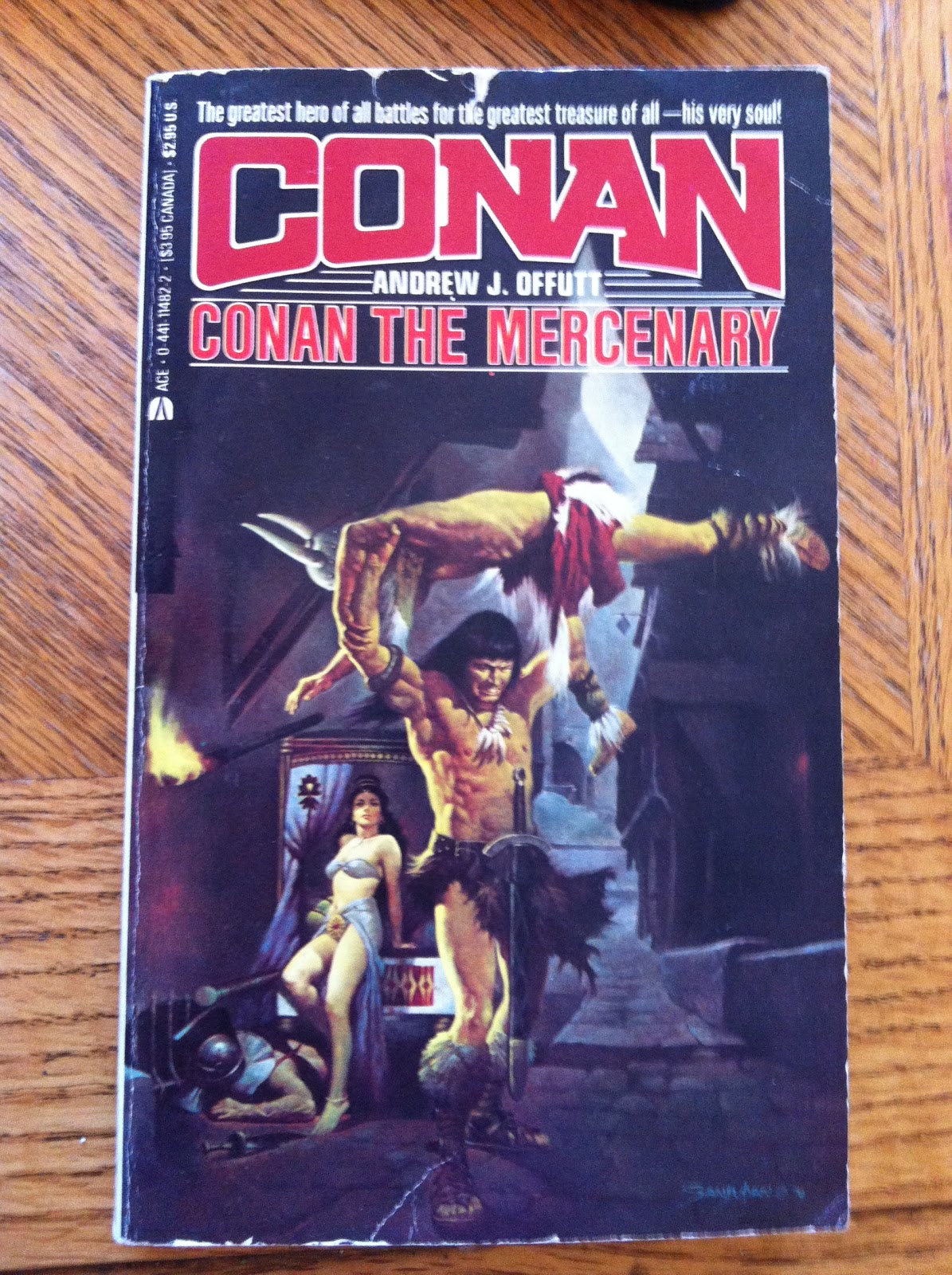
Introduction: Around the age of 12, I read a steady diet of Conan pastiche. A Conan pastiche (to me the word "pastiche" sounds like a good cheese) is a story featuring the character Conan, but not written by Howard (although a pastiche is not a cheese, some Conan pastiche are indeed cheesy). It was not until the recent publication of Howard's works in their unadulterated entirety that I made the move from a "works of Howard fan" to a "Robert E. Howard fan". While I am now solidly in the camp of REH Fans, I am not a pastiche snob, meaning, I will give a pastiche a good shake without immediate dismissal. Some recent lucky finds at a yard sale have given me liberty to dive into the realm of Conan pastiche. Some works I am re-reading after 25 years, others I am reading for the first time.

The Skinny: Conan and the Sorcerer and Conan The Mercenary were written in 1978 and 1980 respectively. They were published by Ace Fantasy, written by Andrew J. Offutt and featured about 50 internal illustrations each by the artist Esteban Maroto.  They were written as "Mercenary" being a sequel of sorts to "Sorcerer"; however, Offutt recaps the events of "Sorcerer" in "Mercenary" well enough that either could be read independently of the other. A third book exists, The Sword of Skelos, that I have not read which makes a trilogy. Andrew J. Offutt has written much Howard pastiche for the character Cormac Mac Art and is also known for his stories adding to the "Thieves World" series, particularly for the creation of the character Shadowspawn. Offutt is also well known for editing the Swords Against Darkness volumes. Esteban Maroto is no stranger to Howard's creations either. He created the famous chain-mail bikini worn by the Howard inspired, but Roy Thomas created, character Red Sonja and was at the forefront of the "Spanish" invasion of comics during the 1970's. His early works were featured in the Warren Publishing titles Creepy, Eerie, and Vampirella.

The plot (SPOILERS ALERT): The two stories take place shortly after Howard's tale "The Tower of the Elephant", feature a very young Conan (his age is placed at 17 in the books) in search of wealth and adventure. The plot of "Sorcerer" has Conan trying to steal a relic called the Eye of Erlik from a sorcerer's tower. While doing so, he stumbles across two other thieves who beat him to the prize; however, it is Conan who is caught by the sorcerer, one Hisarr Zul. Zul is a sorcerer that steals men's souls and forces their soulless bodies into his servitude. Conan encounters some of Hisarr Zul's soulless guardians and is freaked out by them. As punishment for his attempted burglary, Hisarr Zul steals Conan's soul and traps it in a mirror. He then places Conan on a quest to steal back the Eye of Erlik from the thief that made off with it (a lovely she-thief named Isparana). In "Mercenary", after recovering the Eye of Erlik and slaying Hisarr Zul (events which occurred in "Sorcerer"), Conan has recovered the mirror that holds his soul, but is still separated from his soul within. He sells his services to a young, lovely lady noble named Khastris. Conan journeys with her to her homeland in hopes that her cousin, the Queen of Khauran, can join him with his soul (he learned from a sand lich in "Sorcerer" that one way of retrieving his soul is to have the mirror shattered by one wearing a crown). In Khauran, he gets embroiled in a sorcerous plot to take over the kingdom.

The Good: Offutt does not attempt to imitate Howard; instead, he writes in his own voice. This is something I prefer in pastiche versus someone trying to sound like Howard. While Offutt is not, in my opinion, the strongest of writers, he is accomplished enough to push a "Howardesque" yarn along. Complementing Offutt's writing are a healthy dose of illustrations by Esteban Maroto. See examples (with my apologies for my slip-shod photography):
Conan battling the Sand-Lich (Conan and the Sorcerer)

Illustration of Isparana of Zamboula (Conan And the Sorcerer)


Conan rescuing Lady Khashtris from night assassins (Conan the Mercenary


Conan brooding over his murdered lover (Conan the Mercenary)


The Good (continued): The highlight of both short novels for me was Conan's encounter with the Sand-Lich. An indestructible creature clearly out of his league, Offutt doesn't miss a chance to highlight Howard's character and his defiance of death and giving up. All in all, Offutt writes a fast paced yarn, full of well written fight scenes. His portrayal of Hyborea is well done, written with simple, yet effect prose.

The Bad: While I found "Sorcerer" an enjoyable, if forgettable read, "Mercenary" held far less appeal for me. There were three main reasons for this. 1. "Mercenary" lacks a memorable villain. There is a sorcerer introduced in the prologue of the story, but he never makes another appearance. In the prologue, the sorcerer uses his dark arts to make an aging baron appear years younger. The baron hopes to use his young appearing form to strengthen his place in a circle of nobles that have denied him respect and power. It is never explained what this mysterious sorcerer is gaining from this. 2. An interesting back story is set up with the Queen of Khauran, each generation will see the birth of a witch that must be killed. Because of this curse the Queen kills her own child. This has much potential, but is not exploited in the story and rests as back ground noise. 3. Offutt has Conan playing detective in this story, and in the climax, Conan disguises himself as a seer in order to ensnare plotters against the throne in a trap. This rung untrue for me. While I recognize that Conan, as told by Howard, was more intelligent then most give him credit for, it just didn't seem very "Conan-like" to me.

The Ugly: The biggest crime committed in the two short novels occurs in "Mercenary". Offutt commits the crime of "telling versus showing". In about three short paragraphs, he narrates a tale of how Conan is kicked out of the courts of Khauran, falls in love and later in that chapter, broods over the murdered corpse of his young lover vowing that from here on out he will not fall in love. It was way too much story crowded into a short narrative chapter.

Odd Observations: The sand creatures that Conan battled in the 2011 movie Conan the Barbarian share a similarity to Offutt's Sand-Lich in "Sorcerer"; I wonder if there was an inspiration here? The 1997 - 1998 TV series Conan the Adventurer, features as a main villain a sorcerer named Hissah Zuhl (played by Jeremy Kemp). The names Hissah Zuhl and Hisarr Zul strike a certain similarity that again makes me wonder, was Offutt's idea aped for the series?

Conclusion: While I wouldn't recommend these stories as a nice jumping on point for potential Howard enthusiasts, I would recommend them at least as decently written pastiche without glaring non-Howardian faults. The illustrations by Esteban Maroto help elevate them on the list for Conan pastiche collectors, if not as must-haves, then certainly as entertaining curiosities.